Me & Ace: Jamming in the Basement
Expect one of these posts every week or so, as I work on “Me & Ace.” What began as personal therapy has grown into a full-fledged memoir, with roughly thirty-five chapters already outlined. It’s doing what I hoped it would do: help me process the loss of a friend. The spark came while listening to Eddie Trunk’s impromptu show after Ace’s death, hearing metal stars weigh in. It made sense for them. But I knew the guy too. I knew him longer than most. Not better, just our own thing. And our friendship lasted, through sex, drugs, rock n roll, and sobriety
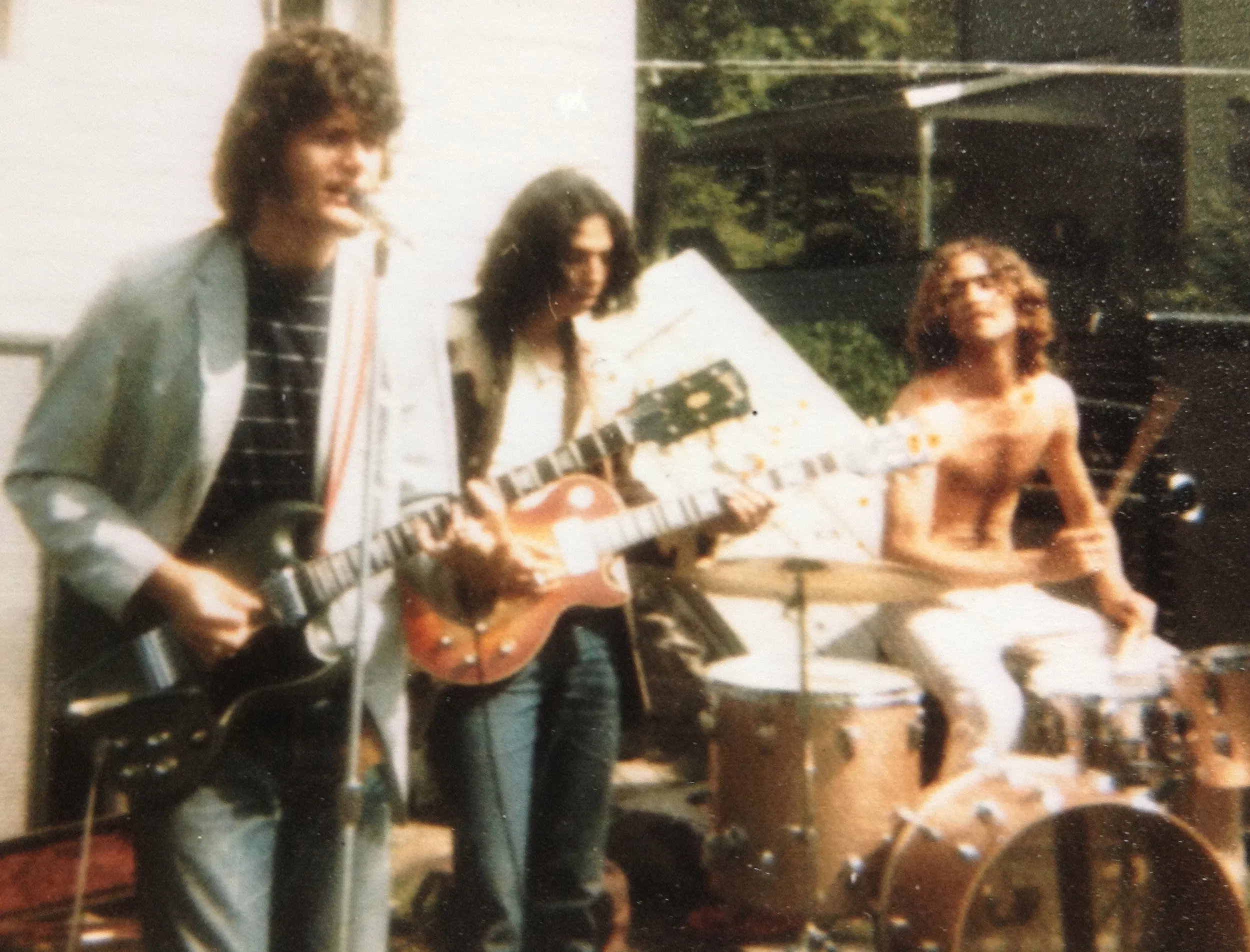
Fresh Garbage with the Bronx guitarist extraordinaire, Angelo Arimborgo, between CC and John O’Meara. Oh, those guitars!
The basement didn’t start as a sanctuary. It started as a necessity.
Fresh Garbage needed a place to rehearse and somewhere to stash our gear. Marion Avenue gave us both. The low ceiling, the exposed pipes, the concrete floor. It wasn’t romantic. It was practical.
Once the equipment was down there, the music followed. And once the music was there, Paul was never far behind.
Paul didn’t call first. He just showed up.
That’s how it worked then. No cell phones. No messages. He knew where to find me, and one afternoon he did. Guitar in hand. No announcement. Just Paul at the door.
Phil Wagner remembers it better than I do. Phil always does. He said Paul arrived like a street kid, roaming the Bronx with his guitar, looking for a place to land. He’s sure it was fall of ’71. No snow on the ground yet. That’s how he dates it. We had just rented the Marion Avenue house in August, and Paul was already orbiting it.
I came down from my room and Phil said, “You two disappeared downstairs.”
The basement was our dungeon.
Low ceiling. Concrete floor. Exposed water pipes running the length of it. We knew the Marshalls would be a problem, so we did what we could. I dragged old rugs down and threw them over the pipes to knock the sound down. It wasn’t elegant, but it helped. A little. A couple of Marshalls always find their way upstairs.
It looked like the Casbah. Pipes draped with carpets. Cables everywhere. Cases cracked open. Two guitars coming out at the same time.
We plugged in and went straight to the blues. Blues was always the touchstone. Probably Jeff Beck’s “Let Me Love You Baby.” That pounding feel. That pocket. We could sit there all day inside that groove. He loved it. So did I.
Those afternoons weren’t just loud. They were focused.
Paul played like there was a crowd watching him even when there wasn’t. Especially when there wasn’t. He started trying out moves, stretching his long arms and legs, forming big shapes with that skinny frame. Giant triangles. Windmills. Dropping low to one knee and popping back up without missing a beat.
Practicing moves, he called it.
I did it too. Rock pout. Album-cover mouth. We were twenty and ridiculous and deadly serious at the same time.
What felt like hours was usually forty-five minutes. People would come home, wander downstairs, say hello. Really they were asking us to turn it down. That was fine. We learned fast. One to four in the afternoon was the sweet spot. Dead zone. You could set off a bomb and nobody would complain.
Between songs, we talked.
Guitars. Pickups. String gauges. Amp settings. How you held a pick. In those days you tuned to a tuning fork. No digital tuners. It never bothered us. We always found the note. That groove. That shuffle.
And sometimes, tucked into the back pocket of his jeans, there it was.
A small bottle. Tango.
Tango was vodka cut with Tang, the powdered orange drink astronauts took into space. Cheap. Sweet. A portable screwdriver. It didn’t announce itself. You only noticed when he reached back, unscrewed the cap, and took a pull like it was nothing.
It didn’t stop the playing. If anything, it fueled it. But it was there. Quiet. Casual. Normalized.
I didn’t think much of it then. Nobody did. We were young. Everyone drank. This was just another accessory, like picks or strings or a strap adjusted too low.
Still, it registered somewhere.
Paul believed in practice the way some people believe in religion. I never felt I could play too much either. At least that’s what we both seemed to think.
Looking back, that basement matters more than almost anything else.
That’s where I saw the difference between us starting to take shape. I was there to play. He was there to become something. He didn’t know what yet, but he was already rehearsing for it.
This would happen every couple of weeks. He never wore out his welcome, but I started skipping more classes than I was used to. He pushed me, too.
I could never master alternate picking, one note on the upstroke, the next on the downstroke. Twice the music for the same motion and the backbone of shredding. Paul had it early. He was well on his way to shredding before the word existed. We fell into a comfortable truth about it. He’d say, “You’re a killer rhythm player,” and I was fine with that. I played my share of leads, but if we’d started a band right then, he would have been out front and I would have been right behind him, holding it together.
The song we kept coming back to was “All Right Now.” He called it the perfect single more than once later at North Lake, and I never disagreed. But back then we just loved playing it. Just the two of us. Rugs on the pipes. Concrete under our feet. No echo. No pedals. No reverb. No fuzz. Just Gibsons into Marshalls, moving air, hands working.
You could feel the wind created by the Marshall. Once, on a lark, I lit a match while he was riffing. I brought the lit match in front of where I could see the outline of a speaker. Blew it right out. That’s some physics.
And the Tango was never far away.
Don’t get me wrong. I wasn’t a goody-two-shoes. I drank. I partook. But I didn’t rely on anything. Not yet. It would be another ten years before I joined that conga line. Back then, I couldn’t tell if the bottle was helping him or getting in the way. It was just there, part of the picture. The Bronx thing. The half-pint riding in the back pocket of his jeans. I remember thinking he might forget it was there and sit down hard.
Alcohol hadn’t become the master yet.
Not for him.
Not for me. Not yet. There were a lot of yets.
Those basement nights weren’t dreams or rehearsals. They were training.
Under rugs and pipes, with Marshalls bleeding upstairs and a bottle of Tango riding shotgun, we were sharpening different tools for the same future, even if we didn’t know it yet.
Paul was preparing to step into the world.
I was preparing to survive it.
The basement led straight to Fresh Garbage.