Me & Ace - A 54-Year Rock ‘n’ Roll Friendship
Expect one of these posts every week or so, as I work on “Me & Ace.” What began as personal therapy has grown into a full-fledged memoir, with roughly thirty-five chapters already outlined. It’s doing what I hoped it would do: help me process the loss of a friend. The spark came while listening to Eddie Trunk’s impromptu show after Ace’s death, hearing metal stars weigh in. It made sense for them. But I knew the guy too. I knew him longer than most. Not better, just our own thing. And our friendship lasted, through sex, drugs, rock n roll, and sobriety.
Fresh Garbage
Chapter 3
In the early 70s, if you were in a band you carried a certain charge. A little swagger. And while our band wasn’t anything legendary, I loved every minute of it and the bonds are still tight today. Still, I was in a band and he wasn’t. That tilted the coolness scale my way, and we both knew it. The fact that we were getting paid, booked by a real agent, gave me an edge I wasn’t ashamed to enjoy.
We were called Fresh Garbage. Let’s get that out of the way. When the band formed in 1969 (a year before I joined), one of the hottest groups on FM radio was Spirit. We didn’t actually play their song “Fresh Garbage,” but the original guys loved the title and grabbed it. Smart choice. Quirky, memorable, very zeitgeist. Back then WNEW-FM was our Bible and WFUV would become a powerhouse later, but not until FM cooled and MTV rose. We did hammer out Spirit’s best tune, “I Got a Line on You,” with its tight syncopated chorus.
Paul knew our band because we played on and off the Fordham campus. On campus, it was basically one venue: the Ramskellar. To this day mixers remain one of the great mysteries of Jesuit education. They were school-approved beer-drinking festivals, which this poster pretty much proves.
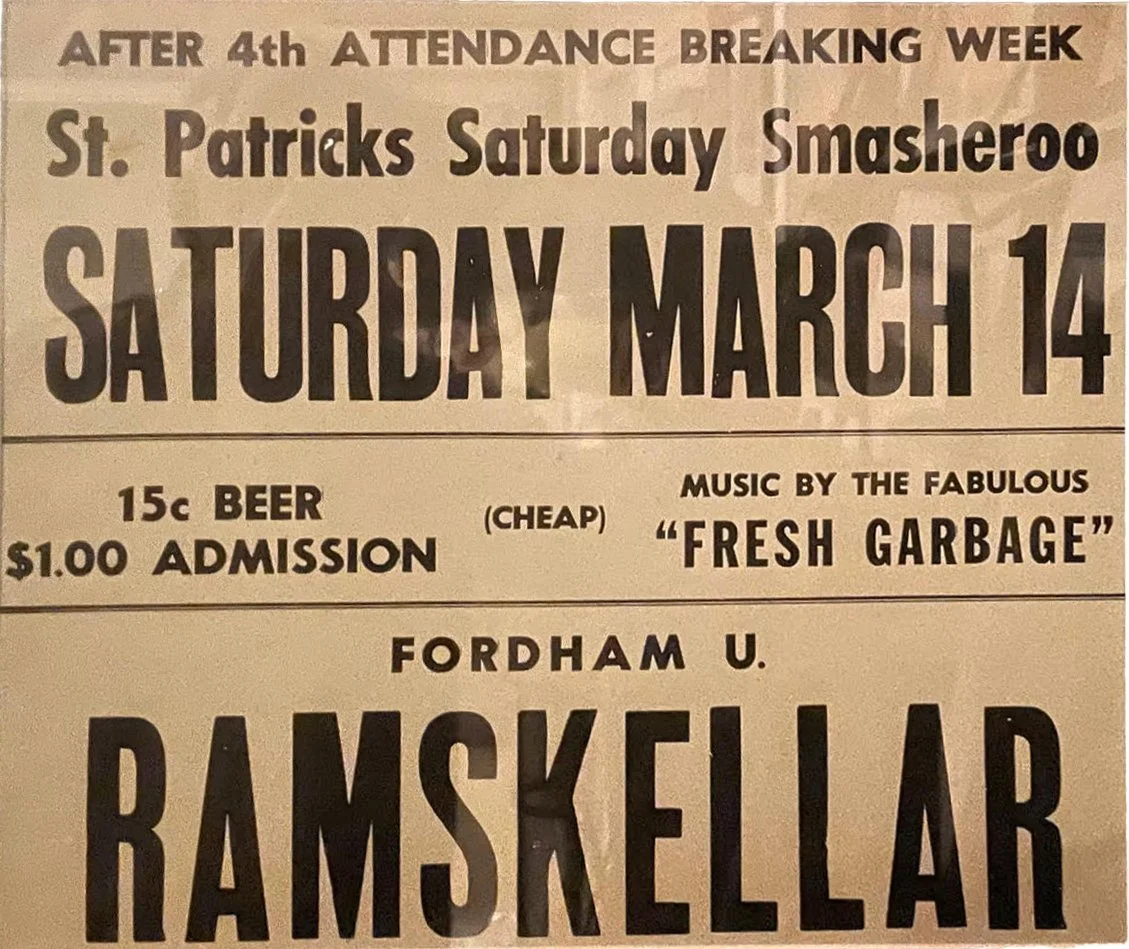
compliments John O’Meara, Class of ‘72 Fordham College
And I still don’t know what the word “cheap” was referring to, the beer or the music.
There were men’s colleges (Fordham, Iona, Manhattan) and women’s colleges (Mount St. Vincent, Marymount, the College of New Rochelle), and everybody invited everybody else to their mixers and their boat rides around the Long Island Sound. It was a whole social economy built on beer, guitars, and opportunity.
The Ramskellar served as our evening cafeteria and, after dark, our brick-and-marble music hall. It felt like an underground cellarium, just swapped out wine barrels for teenagers. Give us two sets and a crowd of thirsty students, and that polite café turned into a pumping, beer-soaked mess of shouting, wobbling kids. Most of us were in our late teens. The Jesuits did a fine job pretending they didn’t see any of it.
Our setlists leaned hard: Rolling Stones, Allman Brothers, a little Tull, James Gang, even some Beatles. Anything with power chords and volume. And volume was our charm. The students wanted loud and we were happy to oblige.
So when he found out where I was playing, Paul showed up one night. It may have been the St. Patrick’s Saturday Smasheroo. Every band has its watchers. Mostly guys, always up front at the side, studying everything. The gear. The fingering. The attitude. Or maybe they just didn’t have a date. I was one of them on my nights off. I’d stand and stare at Rat Race Choir or Billy Vera or Guy and Pipp Gillette, trying to learn something.
We finished a set and the beer was creeping across the floor toward our wires. We had to mop it up or everything would be sticky for weeks. He came right up to me.
“Sounds good tonight,” he said.
Hands tucked in his tight jeans. Thinner than the rest. Rock thin. Back then, there was a kind of rock anorexia that was practically encouraged. It let you wear clothes no guy could usually pull off unless he had money. He had it naturally. He dressed like a star before he was one.
And then he dropped the bomb.
“So, what do you think about me sitting in for a song?”
It caught me sideways. “Why… sure… why not?” I looked him over. “Where’s your guitar?”
“Oh, I’d use yours,” he said, sheepish, giving me that Stan Laurel smile. “If it’s OK.”
By the end of the next set, this crowd wouldn’t care if we banged trash cans into microphones. “Sure. Lemme ask the guys.” I already knew the right song. “How about a Chuck Berry? We do Little Queenie, Stones style.”
His whole face lit up. “Sure. Love it.”
Our dressing room was the dishwasher area of the kitchen. The band sat on empty milk crates while the DJ blasted music outside.
“Guys, my friend Paul wants to sit in on Queenie,” I said. “I’m OK with it.”
Nicky, our lead guitarist, gave me the once-over. “But you’ll still sing, right?”
“Oh, of course. It’s my song.”
Johnny O, our drummer and leader, shrugged. “As long as he knows it, why not? But last song of the set.”
Paul was ecstatic.
The next set was chaos in all the right ways. Dancing drunks, sloshing beer, sparks of young love happening in the corners. One guy was doing Beer Angels on the floor. Poor kid. Poor parents who thought their boy was safe at a Jesuit college.
When Queenie came up, Paul and I switched places. And he did the one thing that immediately annoyed me. He lengthened my guitar strap. My strap was perfect. But he wore the guitar down below his waist, practically to his knees. I had to admit, though, he looked amazing. Totally rock. But I could never play that way. My right arm would be fully extended.
The riff kicked in, that Keith-to-Chuck chug that grabs a crowd by the ribs, and the whole room fell into the groove.
“I got lumps in my throat when I saw her coming down the aisle.”
He dropped in perfect Chuck Berry double-stops.
“I got those wiggles in my knees when she looked at me and sweetly smiled.”
My guitar never sounded so good.
What was his secret?
“C’mon Queenie, let’s get with it.”
Same guitar. Same amp.
What the hell?
“Go, go, go, Little Queenie.”
Whatever it was, he had mojo. Real mojo.
We were twenty-year-old kids in that band, but we learned fast. Not about music so much, but about business. About clients. About club owners. About leverage.
There were dozens of garage bands everywhere, most without agents. We had one. A small office with three guys and a few secretaries booking close to thirty bands across the tri-state area. That alone put us ahead of the pack.
We didn’t have the raw drawing power of some bands. Rat Race Choir, for example, could pull three or four times the money we made. But we worked. We got booked everywhere. Westchester. Rockland County. New Jersey. The Bronx. And our favorite run was out on Long Island.
The Hamptons in the summer were electric. We played clubs that actually pulled crowds, and sometimes it spilled beyond the room. Westhampton Beach had a stage right in the sand. You’d play to hundreds of people during the day, the Atlantic stretching out behind them, and then some of those same faces would follow you to the club at night.
Playing to the ocean was surreal. For a twenty-year-old paying his bills by grinding out “Jumpin’ Jack Flash” and “One Way Out,” it felt like we had arrived. Next stop, stardom. Of course, by morning light, it was clear we were still a cover band with a little juice. But the question stayed with me for years. What was I actually trying to become?
Paul never followed us out to the Hamptons. Maybe he would have liked it. Instead, he showed up where it was rougher. The Bronx.
Especially the Pick.
The Pick n’ Shovel was a working man’s bar, a real Irish joint catering to Fordham students who drank hard and often. Its sister bar, the Pennywhistle, sat closer to Fordham Road and leaned more academic, if you can call it that. They shot scenes from Love Story there. The Pick had something else entirely. A stage surrounded by a fence.
That should tell you something.
The Pick was a red-knuckles bar, and our knuckles earned their color. The dancers pressed right up against the fence, bodies pumping, beer sloshing, tempers short. One night, packed as always, a fight broke out directly in front of my side of the stage. Two or three guys were beating the hell out of a kid who never stood a chance.
It wasn’t fair. It was ugly.
I reached out and shoved one of them away.
Big mistake.
His friend grabbed my Gibson Les Paul Junior, solid mahogany, no mercy. Suddenly I was in a tug-of-war while the others kept pounding the poor guy on the floor. Bouncers finally crashed in and broke it up, but I knew there would be fallout.
During the next set, probably “Midnight Rambler,” which we did well, I looked out into the crowd and saw the same guy. He locked eyes with me and ran his thumb across his throat.
That was enough.
I signaled the bouncer and told him we needed a fast exit. When the lights came up, we were told to head straight out the front door. A car would be waiting.
We stepped onto Webster Avenue and saw it about a hundred yards away. A station wagon coughing smoke, backfiring, barely alive. The bad guys were gathering down the block in the opposite direction.
We sprinted.
The junk wagon stalled. Then turned over. We piled in and tore off just as the other group started moving our way.
We made it back to the Marion Avenue house.
Another night survived.