
Me & Ace: Jamming in the Basement
Expect one of these posts every week or so, as I work on “Me & Ace.” What began as personal therapy has grown into a full-fledged memoir, with roughly thirty-five chapters already outlined. It’s doing what I hoped it would do: help me process the loss of a friend. The spark came while listening to Eddie Trunk’s impromptu show after Ace’s death, hearing metal stars weigh in. It made sense for them. But I knew the guy too. I knew him longer than most. Not better, just our own thing. And our friendship lasted, through sex, drugs, rock n roll, and sobriety
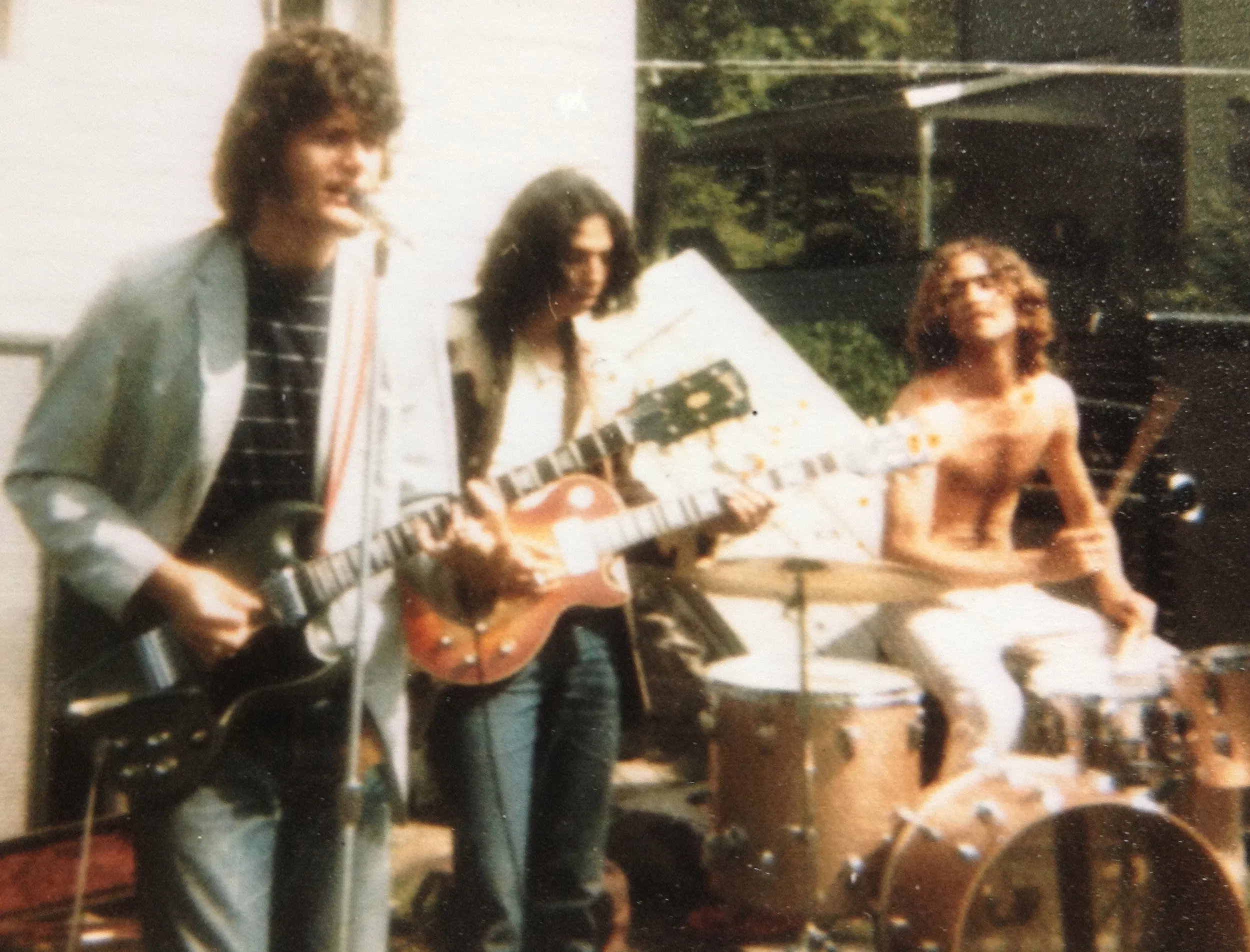
Fresh Garbage with the Bronx guitarist extraordinaire, Angelo Arimborgo, between CC and John O’Meara. Oh, those guitars!
The basement didn’t start as a sanctuary. It started as a necessity.
Fresh Garbage needed a place to rehearse and somewhere to stash our gear. Marion Avenue gave us both. The low ceiling, the exposed pipes, the concrete floor. It wasn’t romantic. It was practical.
Once the equipment was down there, the music followed. And once the music was there, Paul was never far behind.
Paul didn’t call first. He just showed up.
That’s how it worked then. No cell phones. No messages. He knew where to find me, and one afternoon he did. Guitar in hand. No announcement. Just Paul at the door.
Phil Wagner remembers it better than I do. Phil always does. He said Paul arrived like a street kid, roaming the Bronx with his guitar, looking for a place to land. He’s sure it was fall of ’71. No snow on the ground yet. That’s how he dates it. We had just rented the Marion Avenue house in August, and Paul was already orbiting it.
I came down from my room and Phil said, “You two disappeared downstairs.”
The basement was our dungeon.
Low ceiling. Concrete floor. Exposed water pipes running the length of it. We knew the Marshalls would be a problem, so we did what we could. I dragged old rugs down and threw them over the pipes to knock the sound down. It wasn’t elegant, but it helped. A little. A couple of Marshalls always find their way upstairs.
It looked like the Casbah. Pipes draped with carpets. Cables everywhere. Cases cracked open. Two guitars coming out at the same time.
We plugged in and went straight to the blues. Blues was always the touchstone. Probably Jeff Beck’s “Let Me Love You Baby.” That pounding feel. That pocket. We could sit there all day inside that groove. He loved it. So did I.
Those afternoons weren’t just loud. They were focused.
Paul played like there was a crowd watching him even when there wasn’t. Especially when there wasn’t. He started trying out moves, stretching his long arms and legs, forming big shapes with that skinny frame. Giant triangles. Windmills. Dropping low to one knee and popping back up without missing a beat.
Practicing moves, he called it.
I did it too. Rock pout. Album-cover mouth. We were twenty and ridiculous and deadly serious at the same time.
What felt like hours was usually forty-five minutes. People would come home, wander downstairs, say hello. Really they were asking us to turn it down. That was fine. We learned fast. One to four in the afternoon was the sweet spot. Dead zone. You could set off a bomb and nobody would complain.
Between songs, we talked.
Guitars. Pickups. String gauges. Amp settings. How you held a pick. In those days you tuned to a tuning fork. No digital tuners. It never bothered us. We always found the note. That groove. That shuffle.
And sometimes, tucked into the back pocket of his jeans, there it was.
A small bottle. Tango.
Tango was vodka cut with Tang, the powdered orange drink astronauts took into space. Cheap. Sweet. A portable screwdriver. It didn’t announce itself. You only noticed when he reached back, unscrewed the cap, and took a pull like it was nothing.
It didn’t stop the playing. If anything, it fueled it. But it was there. Quiet. Casual. Normalized.
I didn’t think much of it then. Nobody did. We were young. Everyone drank. This was just another accessory, like picks or strings or a strap adjusted too low.
Still, it registered somewhere.
Paul believed in practice the way some people believe in religion. I never felt I could play too much either. At least that’s what we both seemed to think.
Looking back, that basement matters more than almost anything else.
That’s where I saw the difference between us starting to take shape. I was there to play. He was there to become something. He didn’t know what yet, but he was already rehearsing for it.
This would happen every couple of weeks. He never wore out his welcome, but I started skipping more classes than I was used to. He pushed me, too.
I could never master alternate picking, one note on the upstroke, the next on the downstroke. Twice the music for the same motion and the backbone of shredding. Paul had it early. He was well on his way to shredding before the word existed. We fell into a comfortable truth about it. He’d say, “You’re a killer rhythm player,” and I was fine with that. I played my share of leads, but if we’d started a band right then, he would have been out front and I would have been right behind him, holding it together.
The song we kept coming back to was “All Right Now.” He called it the perfect single more than once later at North Lake, and I never disagreed. But back then we just loved playing it. Just the two of us. Rugs on the pipes. Concrete under our feet. No echo. No pedals. No reverb. No fuzz. Just Gibsons into Marshalls, moving air, hands working.
You could feel the wind created by the Marshall. Once, on a lark, I lit a match while he was riffing. I brought the lit match in front of where I could see the outline of a speaker. Blew it right out. That’s some physics.
And the Tango was never far away.
Don’t get me wrong. I wasn’t a goody-two-shoes. I drank. I partook. But I didn’t rely on anything. Not yet. It would be another ten years before I joined that conga line. Back then, I couldn’t tell if the bottle was helping him or getting in the way. It was just there, part of the picture. The Bronx thing. The half-pint riding in the back pocket of his jeans. I remember thinking he might forget it was there and sit down hard.
Alcohol hadn’t become the master yet.
Not for him.
Not for me. Not yet. There were a lot of yets.
Those basement nights weren’t dreams or rehearsals. They were training.
Under rugs and pipes, with Marshalls bleeding upstairs and a bottle of Tango riding shotgun, we were sharpening different tools for the same future, even if we didn’t know it yet.
Paul was preparing to step into the world.
I was preparing to survive it.
The basement led straight to Fresh Garbage.
Me & Ace - A 54-Year Rock ‘n’ Roll Friendship
Expect one of these posts every week or so, as I work on “Me & Ace.” What began as personal therapy has grown into a full-fledged memoir, with roughly thirty-five chapters already outlined. It’s doing what I hoped it would do: help me process the loss of a friend. The spark came while listening to Eddie Trunk’s impromptu show after Ace’s death, hearing metal stars weigh in. It made sense for them. But I knew the guy too. I knew him longer than most. Not better, just our own thing. And our friendship lasted, through sex, drugs, rock n roll, and sobriety.
Fresh Garbage
Chapter 3
In the early 70s, if you were in a band you carried a certain charge. A little swagger. And while our band wasn’t anything legendary, I loved every minute of it and the bonds are still tight today. Still, I was in a band and he wasn’t. That tilted the coolness scale my way, and we both knew it. The fact that we were getting paid, booked by a real agent, gave me an edge I wasn’t ashamed to enjoy.
We were called Fresh Garbage. Let’s get that out of the way. When the band formed in 1969 (a year before I joined), one of the hottest groups on FM radio was Spirit. We didn’t actually play their song “Fresh Garbage,” but the original guys loved the title and grabbed it. Smart choice. Quirky, memorable, very zeitgeist. Back then WNEW-FM was our Bible and WFUV would become a powerhouse later, but not until FM cooled and MTV rose. We did hammer out Spirit’s best tune, “I Got a Line on You,” with its tight syncopated chorus.
Paul knew our band because we played on and off the Fordham campus. On campus, it was basically one venue: the Ramskellar. To this day mixers remain one of the great mysteries of Jesuit education. They were school-approved beer-drinking festivals, which this poster pretty much proves.
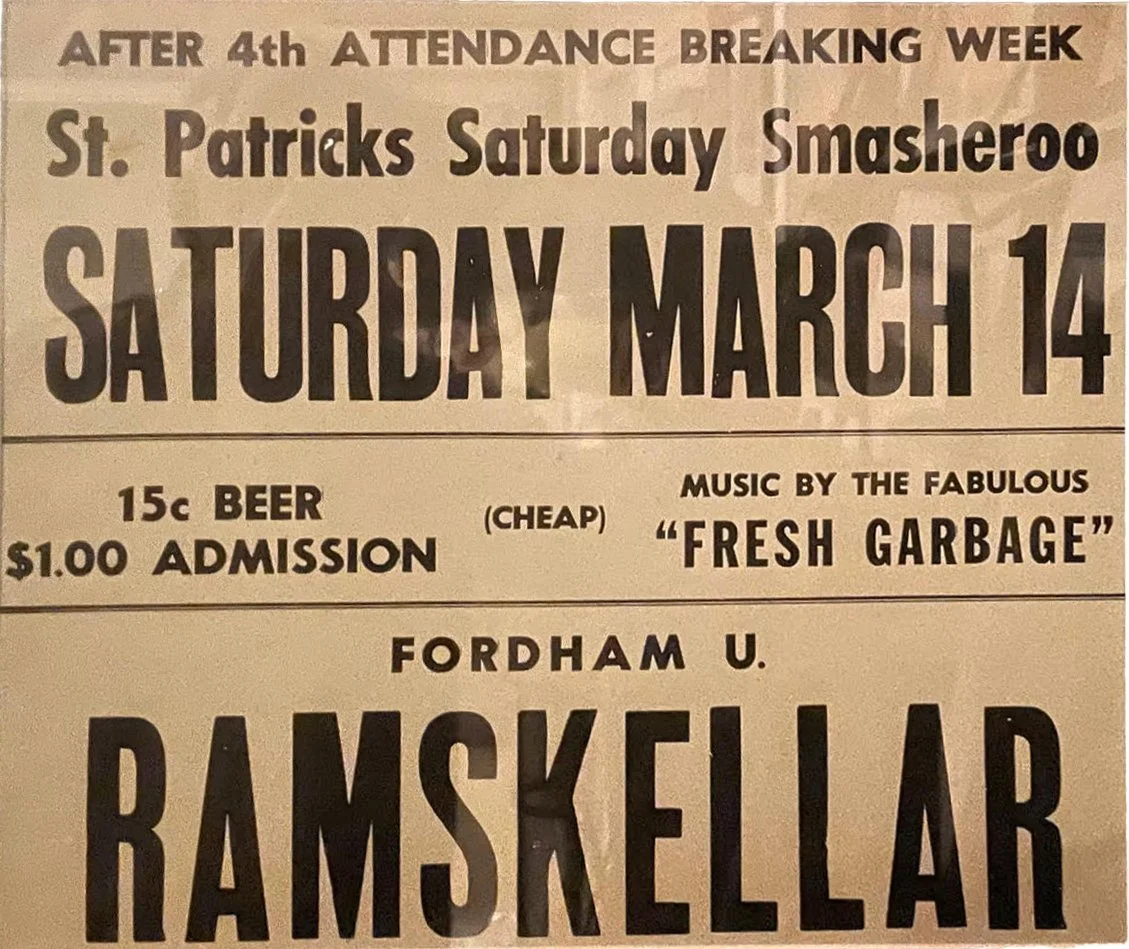
compliments John O’Meara, Class of ‘72 Fordham College
And I still don’t know what the word “cheap” was referring to, the beer or the music.
There were men’s colleges (Fordham, Iona, Manhattan) and women’s colleges (Mount St. Vincent, Marymount, the College of New Rochelle), and everybody invited everybody else to their mixers and their boat rides around the Long Island Sound. It was a whole social economy built on beer, guitars, and opportunity.
The Ramskellar served as our evening cafeteria and, after dark, our brick-and-marble music hall. It felt like an underground cellarium, just swapped out wine barrels for teenagers. Give us two sets and a crowd of thirsty students, and that polite café turned into a pumping, beer-soaked mess of shouting, wobbling kids. Most of us were in our late teens. The Jesuits did a fine job pretending they didn’t see any of it.
Our setlists leaned hard: Rolling Stones, Allman Brothers, a little Tull, James Gang, even some Beatles. Anything with power chords and volume. And volume was our charm. The students wanted loud and we were happy to oblige.
So when he found out where I was playing, Paul showed up one night. It may have been the St. Patrick’s Saturday Smasheroo. Every band has its watchers. Mostly guys, always up front at the side, studying everything. The gear. The fingering. The attitude. Or maybe they just didn’t have a date. I was one of them on my nights off. I’d stand and stare at Rat Race Choir or Billy Vera or Guy and Pipp Gillette, trying to learn something.
We finished a set and the beer was creeping across the floor toward our wires. We had to mop it up or everything would be sticky for weeks. He came right up to me.
“Sounds good tonight,” he said.
Hands tucked in his tight jeans. Thinner than the rest. Rock thin. Back then, there was a kind of rock anorexia that was practically encouraged. It let you wear clothes no guy could usually pull off unless he had money. He had it naturally. He dressed like a star before he was one.
And then he dropped the bomb.
“So, what do you think about me sitting in for a song?”
It caught me sideways. “Why… sure… why not?” I looked him over. “Where’s your guitar?”
“Oh, I’d use yours,” he said, sheepish, giving me that Stan Laurel smile. “If it’s OK.”
By the end of the next set, this crowd wouldn’t care if we banged trash cans into microphones. “Sure. Lemme ask the guys.” I already knew the right song. “How about a Chuck Berry? We do Little Queenie, Stones style.”
His whole face lit up. “Sure. Love it.”
Our dressing room was the dishwasher area of the kitchen. The band sat on empty milk crates while the DJ blasted music outside.
“Guys, my friend Paul wants to sit in on Queenie,” I said. “I’m OK with it.”
Nicky, our lead guitarist, gave me the once-over. “But you’ll still sing, right?”
“Oh, of course. It’s my song.”
Johnny O, our drummer and leader, shrugged. “As long as he knows it, why not? But last song of the set.”
Paul was ecstatic.
The next set was chaos in all the right ways. Dancing drunks, sloshing beer, sparks of young love happening in the corners. One guy was doing Beer Angels on the floor. Poor kid. Poor parents who thought their boy was safe at a Jesuit college.
When Queenie came up, Paul and I switched places. And he did the one thing that immediately annoyed me. He lengthened my guitar strap. My strap was perfect. But he wore the guitar down below his waist, practically to his knees. I had to admit, though, he looked amazing. Totally rock. But I could never play that way. My right arm would be fully extended.
The riff kicked in, that Keith-to-Chuck chug that grabs a crowd by the ribs, and the whole room fell into the groove.
“I got lumps in my throat when I saw her coming down the aisle.”
He dropped in perfect Chuck Berry double-stops.
“I got those wiggles in my knees when she looked at me and sweetly smiled.”
My guitar never sounded so good.
What was his secret?
“C’mon Queenie, let’s get with it.”
Same guitar. Same amp.
What the hell?
“Go, go, go, Little Queenie.”
Whatever it was, he had mojo. Real mojo.
We were twenty-year-old kids in that band, but we learned fast. Not about music so much, but about business. About clients. About club owners. About leverage.
There were dozens of garage bands everywhere, most without agents. We had one. A small office with three guys and a few secretaries booking close to thirty bands across the tri-state area. That alone put us ahead of the pack.
We didn’t have the raw drawing power of some bands. Rat Race Choir, for example, could pull three or four times the money we made. But we worked. We got booked everywhere. Westchester. Rockland County. New Jersey. The Bronx. And our favorite run was out on Long Island.
The Hamptons in the summer were electric. We played clubs that actually pulled crowds, and sometimes it spilled beyond the room. Westhampton Beach had a stage right in the sand. You’d play to hundreds of people during the day, the Atlantic stretching out behind them, and then some of those same faces would follow you to the club at night.
Playing to the ocean was surreal. For a twenty-year-old paying his bills by grinding out “Jumpin’ Jack Flash” and “One Way Out,” it felt like we had arrived. Next stop, stardom. Of course, by morning light, it was clear we were still a cover band with a little juice. But the question stayed with me for years. What was I actually trying to become?
Paul never followed us out to the Hamptons. Maybe he would have liked it. Instead, he showed up where it was rougher. The Bronx.
Especially the Pick.
The Pick n’ Shovel was a working man’s bar, a real Irish joint catering to Fordham students who drank hard and often. Its sister bar, the Pennywhistle, sat closer to Fordham Road and leaned more academic, if you can call it that. They shot scenes from Love Story there. The Pick had something else entirely. A stage surrounded by a fence.
That should tell you something.
The Pick was a red-knuckles bar, and our knuckles earned their color. The dancers pressed right up against the fence, bodies pumping, beer sloshing, tempers short. One night, packed as always, a fight broke out directly in front of my side of the stage. Two or three guys were beating the hell out of a kid who never stood a chance.
It wasn’t fair. It was ugly.
I reached out and shoved one of them away.
Big mistake.
His friend grabbed my Gibson Les Paul Junior, solid mahogany, no mercy. Suddenly I was in a tug-of-war while the others kept pounding the poor guy on the floor. Bouncers finally crashed in and broke it up, but I knew there would be fallout.
During the next set, probably “Midnight Rambler,” which we did well, I looked out into the crowd and saw the same guy. He locked eyes with me and ran his thumb across his throat.
That was enough.
I signaled the bouncer and told him we needed a fast exit. When the lights came up, we were told to head straight out the front door. A car would be waiting.
We stepped onto Webster Avenue and saw it about a hundred yards away. A station wagon coughing smoke, backfiring, barely alive. The bad guys were gathering down the block in the opposite direction.
We sprinted.
The junk wagon stalled. Then turned over. We piled in and tore off just as the other group started moving our way.
We made it back to the Marion Avenue house.
Another night survived.
“Me & Ace - A 54-Year Rock ‘n’ Roll Friendship”
Expect one of these posts every week or so, as I work on “Me & Ace.” What began as personal therapy has grown into a full-fledged memoir, with roughly thirty-five chapters already outlined. It’s doing what I hoped it would do: help me process the loss of a friend. The spark came while listening to Eddie Trunk’s impromptu show after Ace’s death, hearing metal stars weigh in. It made sense for them. But I knew the guy too. I knew him longer than most. Not better, just our own thing. And our friendship lasted, through sex, drugs, rock n roll, and sobriety.
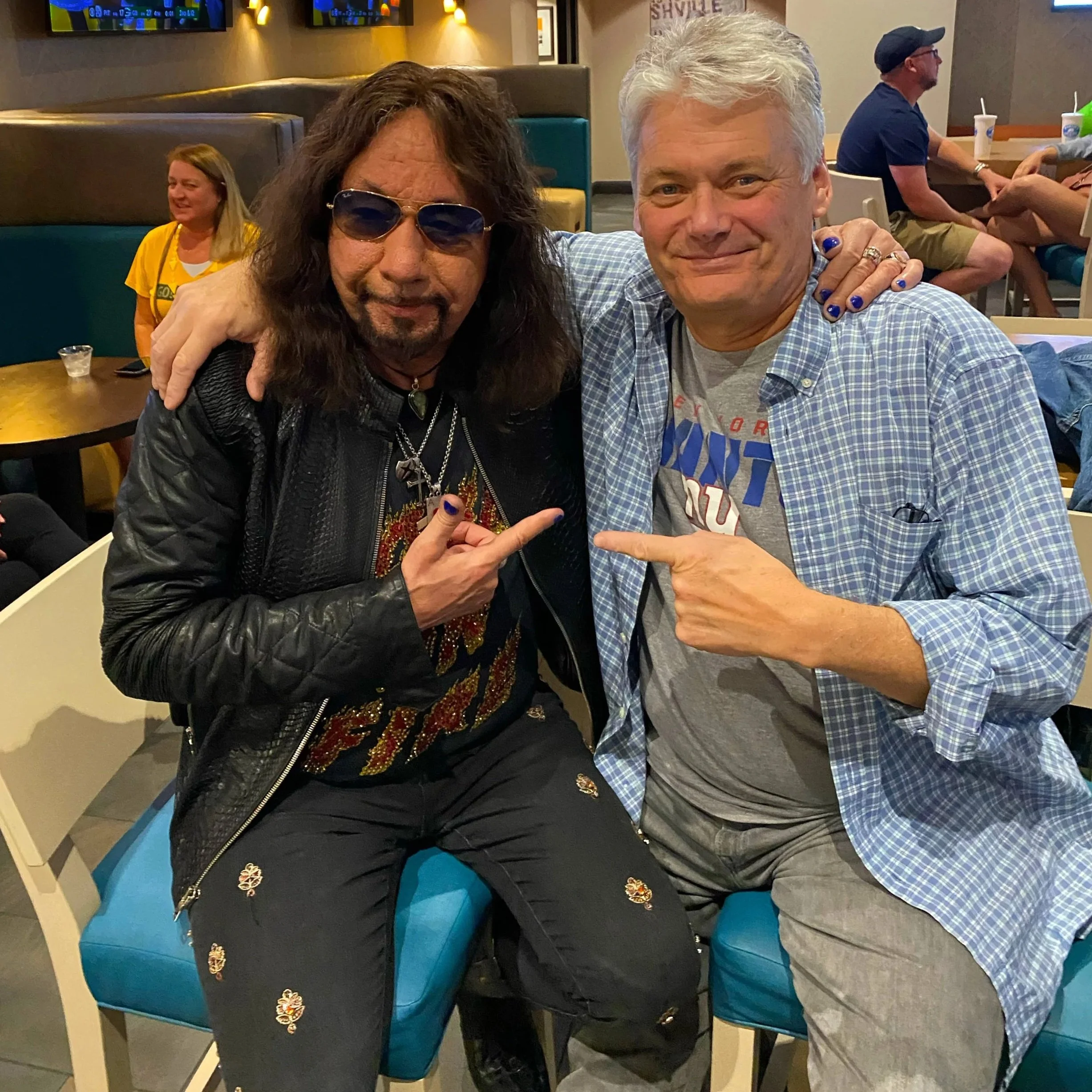
Taken backstage at Ascend Amphitheater in Nashville Oct 3, 2021
HOW WE MET
October 1971
2742 Marion Avenue, corner of 197th Street
It was an unusually warm fall day in the Bronx, the kind where the sun sits just right on the brick buildings and even the pigeons seem relaxed. There were no over-excited drivers honking their horns. And amazingly, no sirens, from fire or police cars. It was like the whole borough had taken a beat.
A handful of us from Fordham University had pooled our meager resources and rented a 2 ½ story house a few blocks off campus. It was perfect for a guy like me. I could walk to class, and more importantly, I could rehearse my band Fresh Garbage in the basement.
Don’t laugh. The name actually got us gigs because it was the title of a song by a band called Spirit everyone knew. Their music was all over WNEW, the FM powerhouse that was required listening back then.
So, there I was, sitting on the front steps and picking with my 1965 Gibson acoustic, the house empty with everyone at class. The Third Avenue El was still standing in those days and trains clattered by every five or ten minutes. Metal screech, track rattle, birds chirping. A perfect score beneath my fingers.
I had been taking lessons from the great Dave Van Ronk, who advertised in the Village Voice. When I saw his ad, I did whatever I had to do to scrape together the money. He taught me old-fashioned-alternating-bass Travis picking. That morning I was working through St. Louis Tickle, an old ragtime song that Van Ronk was famous for. I was trying to get my thumb to think for itself, when I heard a strange scraping, rolling sound.
At first it didn’t register. You know how that happens, where a noise slides into your awareness slowly. Like when the garbage truck climbs the hill toward your house. You hear it before you know you’re hearing it. That was the sound. Only this one went “Brrr-up, clank clank... Brrr-up, clank clank.”
I craned my neck and looked north up Marion Avenue.
What a sight.
A tall, thin kid with a shag haircut, very English-looking, was wrestling a Marshall 8x10 cabinet down the sidewalk. Instead of pulling it, he was pushing it, and on the old slate sidewalks, he could only move it a few feet before lifting and adjusting again.
One look and I knew this was someone I wanted to meet. The haircut screamed Rod Stewart, and the amp bottom said one thing loud and clear - this guy plays.
I immediately changed what I was playing. Literally. I slipped into Jeff Beck’s arrangement of Greensleeves. And sure enough, it caught his ear.
He made it across 197th Street and paused at our corner. Leaning against the Marshall cab, he looked completely out of place and absolutely perfect on the grimy Bronx street corner. Tight black jeans, and I mean tight - spray-on tight. Street Cons, which were black-and-white Converse sneakers. They weren’t fashion statements yet. They were just the cheapest and coolest things you could buy. A Mickey Mouse shirt pulled the whole look together. His shag, rooster haircut belonged under stage lights.
My hair could never do that. My Italian-Irish head of wavy hair didn’t fall like Jeff Beck’s or any of the English guys, and no barber in the Bronx could cut it that way anyway. But this guy pulled it off even while manhandling a giant amp cabinet down the street.
Then he spoke. He couldn’t take his eyes off my Gibson. It wasn’t a top-tier model, but it sounded gorgeous and looked the part.
“That’s one sweet axe, my friend.” He stepped toward me while I kept playing.
“Thanks. I’ve got a couple of electrics inside, but I love this baby.”
He edged closer like he was getting in line for his turn. I didn’t mind. The idea that another guitar player might be in the neighborhood was exciting. And we soon discovered, you couldn’t swing a dead cat without hitting a great guitarist in the Bronx. Angelo Arimborgo. Mike Festa. Eric Paradine. I could go on.
“Is that a Hummingbird?” he asked, revealing he didn’t know acoustics all that well.
“No, not that fancy. This is a J-45.”
“Love the sunburst.” He took one more step. Now he was right in my space, looking at the guitar the way a little kid eyes a toy. “Can I?”
“Be my guest.”
He sat on the front steps and immediately started ripping a lead. Not noodling - ripping. And my guitar had medium strings, which were not exactly easy-bending territory.
“Holy shit. I didn’t know anyone in the neighborhood played like that.” I held out my hand. “My name is Chris.”
He reached across the neck to shake. “I’m Paul. Paul Frehley from Bedford Park.”
He launched into Black Mountain Side by Jimmy Page, and that sealed it. I had to hang with this guy.
He played through the first turnaround, then stood abruptly. “What am I doing? I’m gonna be late for rehearsal.”
“How far are you going?” I pointed toward the driveway. “I’ve got our band’s truck. I can give you a lift.”
“Nah, it’s OK. It’s just down on Decatur.” He grabbed the Marshall cabinet again. “See ya ‘round.” He took a few steps, then turned. “What band are you in?”
“I play with Fresh Garbage.” Everyone knew Fresh Garbage. “We’re at the Pick and Shovel this weekend. Come on by.” I didn’t have the heart to tell him to pull the amp cabinet rather than push it.
And that was how I met Paul Frehley. The rest of the world would come to know him as Ace, but for the first ten years or so, he was Paul to me. That tiny exchange on a street corner in the Bronx defined our relationship for the next fifty-four years. Guitars, amps, gigs, writing songs, recording them. Those were the only things that interested us, and when we were together, nothing else mattered.
Substack became a problem because people with iPhones told me they couldn't get the link to work. ChatGPT says there is an issue there. So, I will post here and anyone who wants can add to their “Tip Jar” below.
“Me & Ace” - The Call
Expect one of these posts every week or so, as I work on “Me & Ace.” What began as personal therapy has grown into a full-fledged memoir, with roughly thirty-five chapters already outlined. It’s doing what I hoped it would do: help me process the loss of a friend. The spark came while listening to Eddie Trunk’s impromptu show after Ace’s death, hearing metal stars weigh in. It made sense for them. But I knew the guy. I knew him longer than most. Not better, just our own thing. And our friendship lasted. We had our own thing that started in the Bronx in 1971. This book will bring you through those 54 years.
We were supposed to meet at a county fair up in Lancaster. It was only an hour from my house, and we hadn’t seen each other since I drove to Sparta, NJ to get his signature on a release for my book “Art of the Stomp Box.” He loved the idea and offered a testimonial for the back cover. Fun fact: the release was his idea, and he told me to protect myself in case something happened to him. “Hey,” he said with a wink, “ you never know.”
After all,
I’m the guy who pointed him toward the audition after he’d sit in with my college cover band in the early 70’s. I recorded his Dynasty demos and picked “2000 Man” for him to cut. We spent long stretches together in the ’80s, partying hard and burning fast. We drifted apart in the ’90s, then found our way back through sobriety in the 2000s, when our friendship was at its best. We wrote songs together, including “Past the Milky Way.” I stayed with him and Rachel while we worked. He recorded lead guitar for my BBQ CD.
And we talked about God.
So why shouldn’t I have a seat at the table? I decided to sit at my own table and tell these stories. And it feels really, really good to do that.
Preface-
October 16, 2025. I was on the phone with Crazy Joe Renda of all people, trying to track down Fred Schminke, who’d once written a radiant review of my Cakeman Chronicles show. I’d been toying with reviving it, or at least turning it into prose. Funny who calls who at moments like that.
Joe (Uh, My Name is Eugene) Renda was the co-owner and manager of North Lake Sound - my first studio engineering gig and where I brought Ace to record tracks to support the Dynasty LP.
“Hello, Oh Grand High Mystic Mumbo.” That’s how John Regan and I would address him. He started a “club” of all the Variable Speed Band members. Even had cards printed up. If you made him laugh, you got a card. If you were a mega-star, you got a card. (Ace, Frampton, and best friend Billy Vera all got cards.) If you were a fine-looking young lady, you definitely got a card.
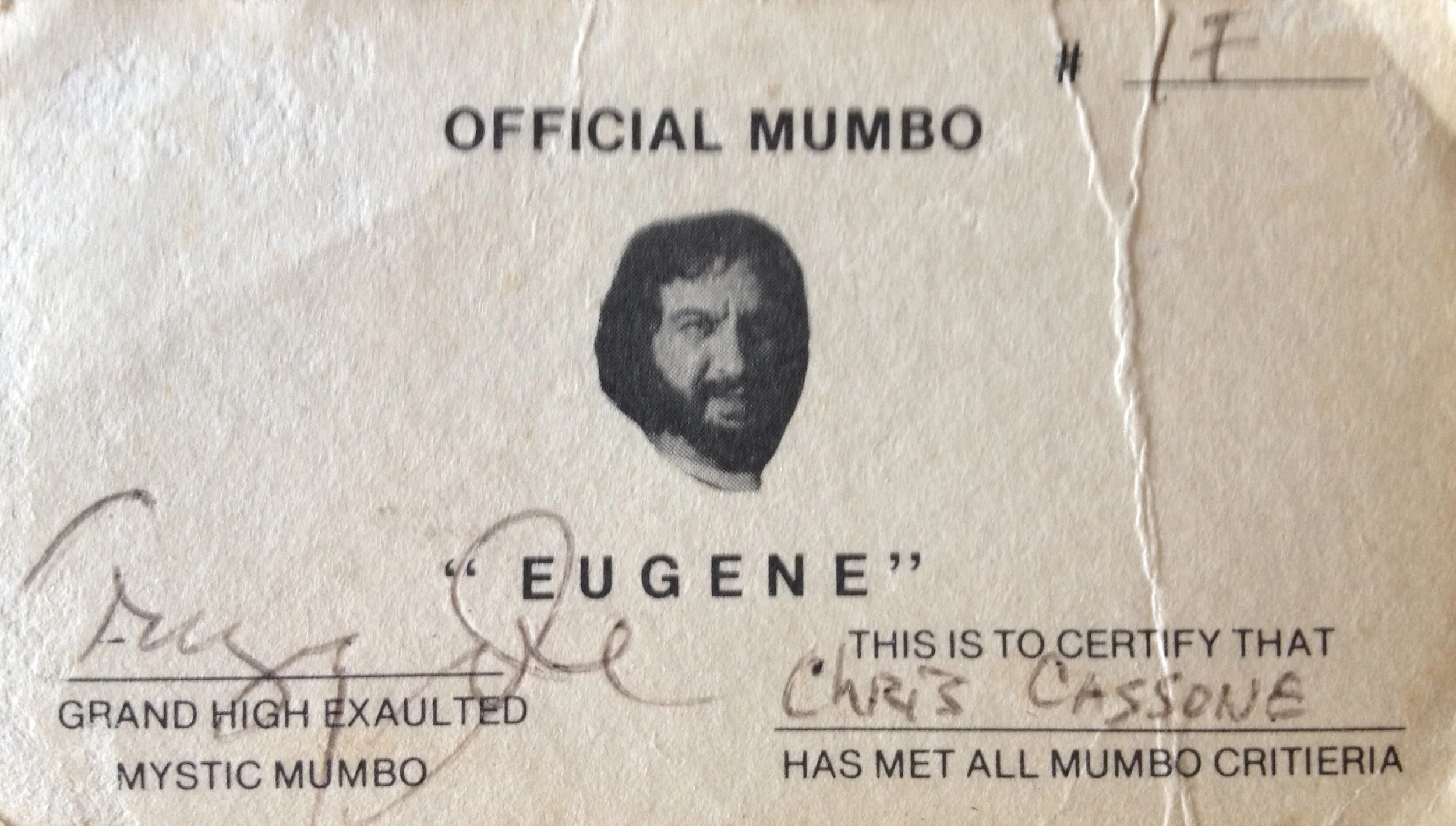
A “Mumbo Card” was only issued by Crazy Joe (Ace, Frampton, Bob Mayo, T. Bone Wolk, Vinny Pastore, Buck Dharma, Blotto, among many others.)
“Skinny used to call me that, you know,” he reminisced, referring to John’s nickname after he lost a ton of weight.
So, I’m talking to Joe when he suddenly blurts out,
“Ace Frehley is dead.”
I corrected him immediately. “He is not dead, Joe. He fell. He’s taking time off,” not knowing about the second fall.
“No,” he said, and I could hear him fumbling with his phone. “It says he died in a hospital in Morristown.”
Time slowed.
My laptop was right there. I typed Ace Frehley into Wikipedia.
And there it was. Past tense.
“Ace Frehley was an American guitarist…”
They had changed it already. That fast. I remember thinking: Who are these people?
The numbness came on quietly.
We were supposed to meet at the Antelope Valley County Fair in Lancaster. He was headlining with Quiet Riot and Vixen. His fall and concussion had canceled it. At the time, we thought it was just that — a bad fall on September 25. A concussion. Enough to ground him for a while.
The second fall was different. A full crash down the stairs in his McMansion in Sparta, New Jersey. Big stairs. Hard stairs. He was a big guy — built like a quarterback or tight end. Not the muscle, but the frame. Put long hair and sunglasses on Travis Kelce or Shannon Sharpe and line them up. Same silhouette.
My phone started lighting up. The news cycle went berserk. He was everywhere. Everyone was talking. Nothing made sense.
I needed someone who knew him. Not better. Not more. Just the way I knew him. A friendship that could be put on hold and picked up again years later, like no time had passed.
There was no one to call.
Not Monique. Not close enough.
Not John Ostrowski. He barely picked up when Ace was alive.
Except him. And I couldn’t call him.
So I did the only thing I know how to do. I kept writing. It helped.
What hurt most was knowing a song we started would never be finished. Space Pirates. He loved the idea — a renegade pilot addressing the crowd, recruiting them to maraud across the galaxy. I wanted him to try it in an arena. If the crowd knew it, they would’ve signed up on the spot.
We lived in our own two-hander. A balance. A rhythm.
I tried listening to Eddie Trunk’s show, desperate to hear someone who knew him. But it didn’t help. He spoke as if the rest of us hadn’t really known Ace. Maybe he wasn’t wrong. He had his own grief, I’m sure. Still, it hurt. I turned it off.
When Kennedy died, I was thirteen. I didn’t understand death, but I knew it hurt. I talked to my mother. She understood. We watched the entire assassination drama play out on her TV, sitting on her bed. I had her.
When John Lennon died, it gutted me. I had friends who loved the Beatles. My first wife, Dale, understood the mystery of it. Still, the ache stayed.
This felt different.
This time, I was alone with it.
I am deep into the memoir now and will edit parts and share them with you. Please respond. That would be helpful.
Next post: How We Met
Where We’re At
It has been almost a year since I started interviews for Stomp Box Art and I am rounding 1st base, heading to second. Why. you say, is it taking so long? Well., a little thing called emergency open-heart surgery got in the way.
I ran a 5K on May 12, 2024, with the hopes of getting back into shape. You know, shedding some of those pandemic pounds. I was a bit out of breath but all normal for someone starting the routine again. And mine always includes road races.
So when I walked upstairs the next morning and dropped to my knees, that got my attention. Luckily I already had an appointment in a few hours with my cardiologist.
Long story short: I had an emergency triple-bypass and a new aortic valve replaced. Needless to say, the book was put on hold for almost six months as I rehabbed myself back to somewhat normal living.

8 days in a coma, 23 in the hospital. Fun times on a heart-lung machine
Since the new year I have been back at the interviews and writing. In fact, my original plan was fifty companies at four pages each. I have finished thirty interviews (mostly on Zoom) and setting up more every day.
The big slowdown now is photos. I need high resolution (300dpi) of their pedals and many companies simply do not have publish-ready photos. Most have Web resolution of 72dpi and that has been the problem.
I have solutions.
If they don’t possess the photos, I will take them myself in my new photo studio in the garage. With a very competent Nikon D750 (20mm-120mm) and a light box with all the accessories, we are doing fine.
Some companies just sent me the pedals. I will make it clear here just like I do in my correspondence - I AM NOT LOOKING FOR FREE STUFF!
More than a few are loaning them to me. Robert Keeley and Josh Scott just shipped them to me (3-5 pedals) with return packaging. Easy peasy.
Some are harder to work out but I must include them. I am going to Guitar Center here in Hollywood to ask if I can shoot several right out of the display case.
And then there are the few that refuse to participate. I can’t speak for them but I just don’t get it. I have had a monster firm like Electro Harmonix open their doors and their hearts for me. What a great time I had with Owen Matthews, his dad, Mike Matthews, and the staff- all corralled by VP Mike Castellano.
The thing is, when they see this book they are going to kick themselves that they didn’t participate. I believe in it that much. I am meeting such a sweeping eclectic group of artists. Yes, these designers are true artists.
Pilgrimage to Electro Harmonix
On January 9th during a quick trip east to see the family, I was invited by EHX Vice President of Marketing Mike Castellano to get the cook’s tour of arguably the country’s oldest and largest pedal concern. Founded during the heyday of the music explosion in late 1968, owner, CEO and basic guiding force of EHX, Mike Matthews, gave me a brief audience during the tour.
Mike Castellano was aware of my Cakeman Saga as well as “Route 22,” (he lives off it in Westchester,) so I came prepared with cakes, cookies and bread from the family’s J.J. Cassone Bakery.

The Cakeman with his wares for Mike Matthews at Electro Harmonix
I got the full tour with Mike and Owen Matthews, Mike’s heir-apparent who I met last year at NAMM. We saw the design stages, assembly rooms, testing (with real guitar loops!) and finally the massive shipping hall. My head was spinning as we passed hundreds of stacked Big Muff’s, Mel 9’s and new favorite, the Ravish Sitar pedal.
What srurck me was how innovative the company remains. I mean, there are only five basic pedal styles but they keep digging and coming up with newer ideas that the guitar-playing public seems to love.


A 12-Year-Old’s First Job - and First View of Evil
Have no fear.
Surround yourself with winners.
Always believe that your dreams can come true.

My grandfather’s bakery
I guess I had several “first” jobs. My very first time I received money for my time was when I was 6 and my Uncle Rocky needed me to bag rolls for the bakery shop store on Sunday mornings. After mass got out, especially 9 and 10:30, the line was out the door for bread and cakes and almost everyone wanted fresh rolls for Sunday breakfast or dinner. My Uncle, in front of my Dad, “interviewed me” to make me take the whole process serious. He offered me 10 cents and hour and, truth be told, I would have done it for free. The responsibility amped this 6 year old up. And I soon found out that I was on stage behind the counter. The crowd would include someone invariably who knew who I was and would call me out. I felt very important as the ladies who sold the goods would call out “half” or “dozen” and bang, I’d have to bag them lightning fast. I would bag them ahead of time on big days like Sundays in Lent and the big holidays. Bagging rolls brought me into the family business well enough but I wasn’t to spend too much time there until after college when I had a delivery route.

Our bakery store was always mobbed after 9 AM MASS
The big first job for me and many other enterprising kids was “Paperboy.” Again, the job had a lot of responsibility and I took it very seriously. You had tio be twelve and apply for “working papers,” a technicality to protect us against child slavery. It was a real coming of age moment to get your working papers. My Mom was with me throughout the procedure which included an interview with the head of delivery at the Port Chester Daily Item, downtown in the town square.
This included my Mom putting up a bond for me so they were never on the hook for me running off with their money. Once I passed the interview, I was handed my “book” with a page for each customer (maybe I had 50 customers) and my paper bag. This was a canvas sack that would hold all my papers. They dropped the papers off in front of my house in a wired bundle and I filled up my sack and off I went. The director took me around the first day and showed me the ropes. Everyone seemed to get a paper in those days. Besides citizens, the bak, the local bar, a couple of hair salons, even the firehouse.
Then on Thursdays we’d collect for the week before. If I remember correctly, a weeks papers cost 75 cents which left a perfect 25 cents for a tip if they gave me dollar. I would knock and yell out, “Collect!” and they would search for the money and pay me off. I loved it and soon became a coin collector with all the change flowing through my hands. There are several stories that have stayed with me all my life that must be told.
One summer, August 7, 1962 to be exact, I stopped in to drop off the paper to the bar, Manley’s on Irving Avenue. Manleys would figure into this young drinker when I was 18. But the bartender would offer this 12 year old a soda once in a while and this Tuesday was particularly hot and they had the Yankee game on. I remember it like it was yesterday because Tony Kubek was back from military service and at his first at bat, he hits a home run. Like I said, I’ll never forget it.
But there is one more episode that is indelible in my memory, and certainly not so joyous. Prospect Street was a block away from my home and I had just a few more deliveries to make. It was that same sluggish and hot summer where everything moved in slow motion and the only thing you could hear were the cicadas in the air, buzzing and rattling out of their shells. So up Prospect Street, past the Elks’ big house on the corner was a rooming house where I had several accounts. As I walked up the hill to the house, a large Victorian with a broad stairway, I detected a fight or something similar coming from inside and upstairs. The front door was wide open and normal for a Saturday. The punching and falling and smacking around got louder. It sounded like someone was getting beaten up. And soon I found out I wasn’t far off because eventually the fight made it to the front door and it wasn’t a fight, not a fair one for sure. It was a young, tough guy newlywed beating up his young blond bride who just sobbed and screeched for help. No one helped. I saw heads peak out around their window shades but no one intervened. I stood there frozen as the tough guy looked at me and screamed, “What are you going to do about it?” Well, I certainly didn’t even have a response much less a reaction to help. He was muscle-bound and a man. I was a twelve-year old kid with a bag of papers over my shoulder.
Once he realized he was still the tough guy, he hauled off and kicked her down the front stairs until she rolled onto the gravel driveway. I saw blood. I wanted to help. Really I did but I never saw such evil right in front of my eyes before. He dragged her into the front seat of the car and after another slap across the face, he drove off. My shaking didn’t stop as I delivered the last of my papers. Luckily I didn’t have to collect because I surely did not want to come eye to eye to the cowards who lived there. When I got home I told my parents of the incident and my Mom called the police. Turns out they knew all about him and were waiting for the right time to arrest him. My dad said that wouldn’t change things. He would probably beat her harder when he got out.
As I said, it’s like it was yesterday and if only I could walk up to that piece of garbage now. I still feel guilty that I had nothing to offer her when her eyes locked into mine searching for help. Remember, I was twelve and I had the freedom to walk in a twelve block radius around town, cross streets, walk into buildings, sometimes even into people’s apartments waiting to get paid. It was a job I was proud to have and love to talk about but one where I learned that life wasn’t pretty. That young blushing brides could get the stuffing beat out of them by their own husbands and most of the neighborhood looked the other way. Whew.

A stock image from Georgia but very similar.